
French Drain Installation in Halifax: Cost & Depth (2026)
What a French drain is, how deep it goes, what drives the cost in Halifax, and when a cheaper fix works better. From a local excavation contractor. Free quote: (902) 221-4582.
A Halifax excavation contractor on French drains: how they work, how deep they go, what moves the price, and the cheaper fixes to try first.
French Drain Installation in Halifax: Cost, Depth, and When You Actually Need One
If your lawn stays soggy for three days after every rain, or water keeps finding its way toward your basement, somebody has probably told you that you need a French drain. Sometimes they are right. Sometimes a forty dollar downspout extension would have done the job. Here is how a French drain actually works, how deep it goes in Halifax, what drives the cost, and how to tell whether it is the right fix for your yard before anyone starts digging.
French drains in Halifax at a glance
What it is: a trench of clean stone with a perforated pipe that collects water and carries it away
Typical depth: about 18 to 24 inches for a yard drain
Must have: a steady fall to an outlet the whole way
How it is priced: as a whole job after a site visit. Excavator and operator $150/hour, labour $75/hour
Try first: downspout extensions and regrading, which are often cheaper and sometimes all you need
What is a French drain?
A French drain is a trench filled with clean, washed stone, with a perforated pipe running along the bottom. The whole thing is wrapped in filter fabric. Water soaks down through the soil into the stone, finds its way into the holes in the pipe, and runs downhill through the pipe to somewhere that is not your yard or your foundation.
Each layer has a job. The stone gives water an easy path to move through instead of sitting in the soil. The pipe carries it away quickly once it gets there. The fabric keeps fine soil from washing into the stone and slowly clogging it. Leave out any one of those and the drain works for a season or two and then quietly stops.
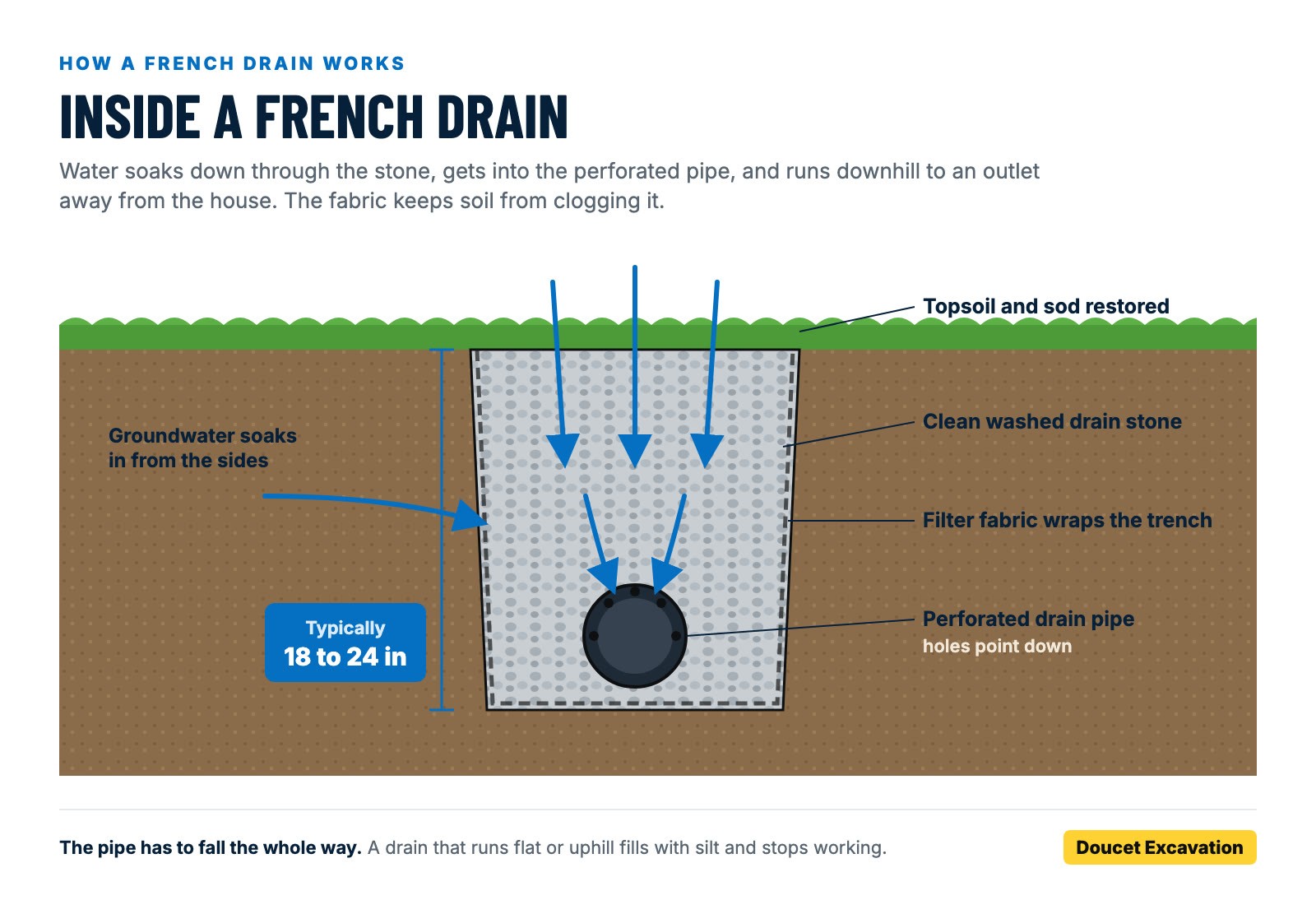
How the layers work together. The pipe only works if it keeps falling to the outlet.
Do you actually need one?
This is the part most people skip, and it is where money gets wasted. A French drain is good at one thing: pulling water out of soil that stays wet and moving it somewhere else. It is not the right answer to every wet yard.
If your downspouts are dumping roof water right beside the foundation, extend them first. That is the cheapest fix there is, and a surprising amount of water in Halifax basements is just roof water landing in the wrong place. If your whole yard slopes toward the house, a drain helps but it is fighting the ground. Regrading so the land runs away from the house fixes the cause instead of catching the symptom.
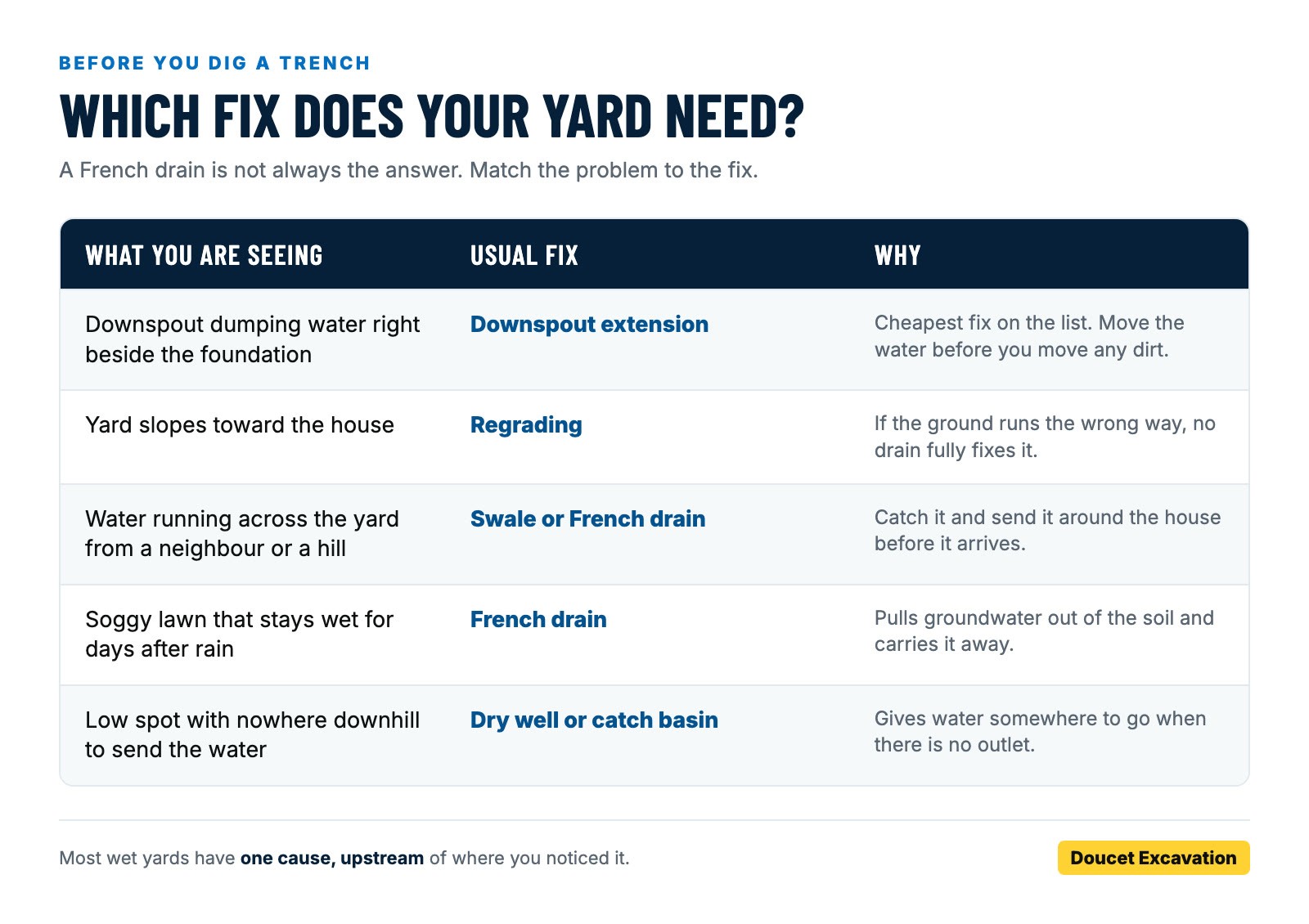
Match what you are seeing to the fix before you pay for a trench.
Where a French drain earns its money is a lawn that stays saturated long after the rain has stopped, water moving across your property from a neighbour's lot or a hill, and ground that is wet because of what is underneath it rather than what is landing on it. If there is nowhere downhill to send the water, a dry well or catch basin usually comes into it too.
How deep does a French drain need to go in Halifax?
For a typical yard drain, the trench usually runs about 18 to 24 inches deep. The exact depth is set by two things: where the water is sitting in the soil, and where the outlet is. The trench has to be deep enough to catch the water and still keep falling all the way to wherever it drains.
You will read online that a drain has to go below the frost line, which is around four feet here. For a drain in the middle of a lawn that is usually not the case, and digging that deep for no reason roughly doubles the work. A drain protecting a foundation is a different job, and there the depth is set by the footing, not the lawn. That is a good example of why these get quoted on site rather than over the phone.
The one rule that does not bend is fall. The pipe has to slope downhill the whole way, commonly at least about an eighth of an inch per foot. A drain that runs flat, or dips and rises, collects silt in the low spots and stops working. Most failed drains we see did not fail because of the pipe. They failed because somebody eyeballed the slope.
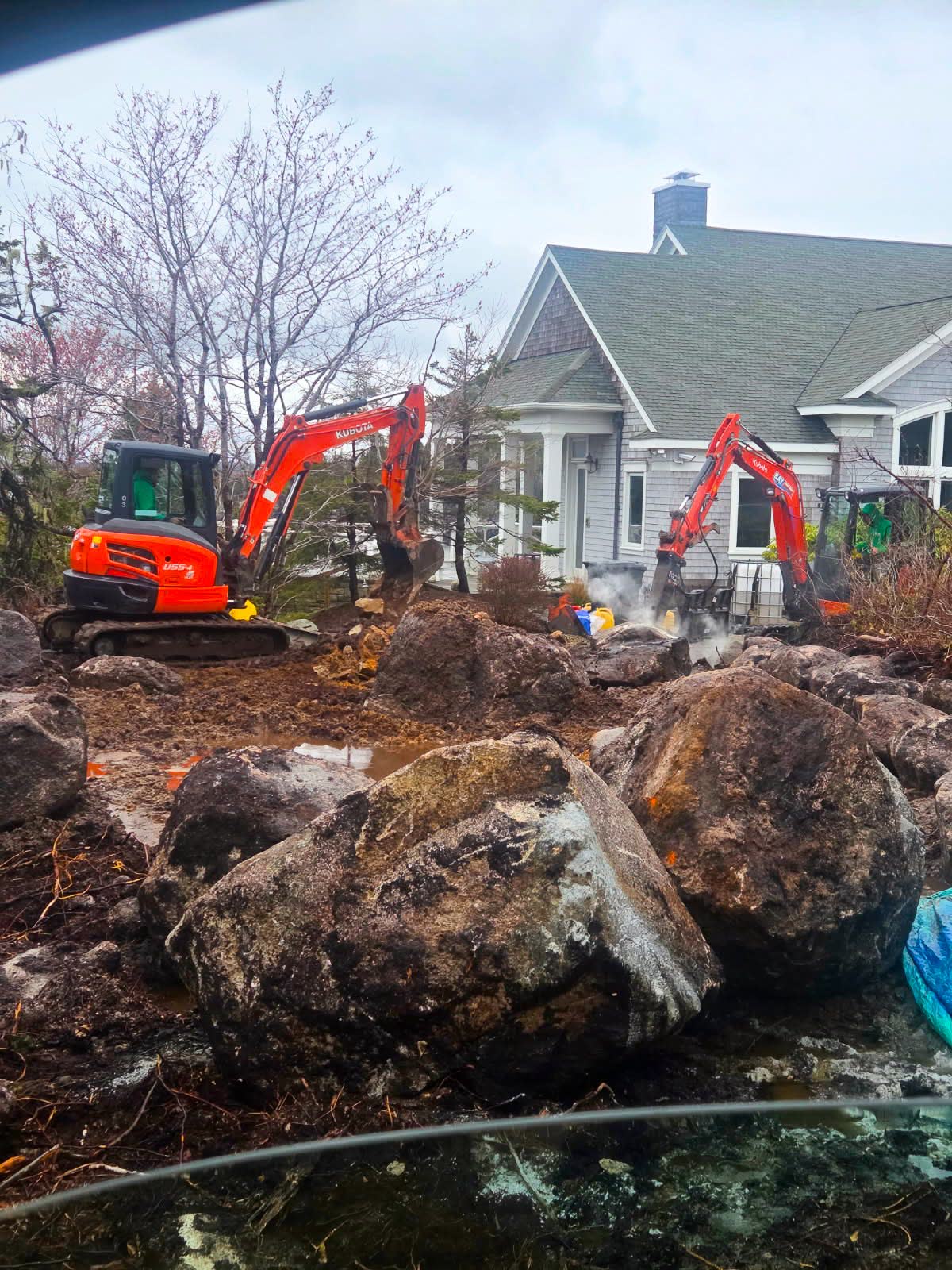
The machine work is fast. Setting the fall correctly is what takes care.
How much does a French drain cost in Halifax?
We quote every drainage job as a whole after seeing the site, because two drains the same length can be completely different jobs. What sits underneath the price is our excavator and operator at $150 an hour and labour at $75 an hour, plus the stone, pipe and fabric.
Six things decide where your job lands. Length is the obvious one. Depth matters because a deeper trench moves more material. The outlet matters more than people expect, since a long run to get the water somewhere useful can cost more than the drain itself. Access decides whether a machine can do the work or part of it has to be dug by hand. Rock, roots, old fill and buried utilities all slow a trench down. And whatever was on top, sod, pavers or a walkway, has to go back.
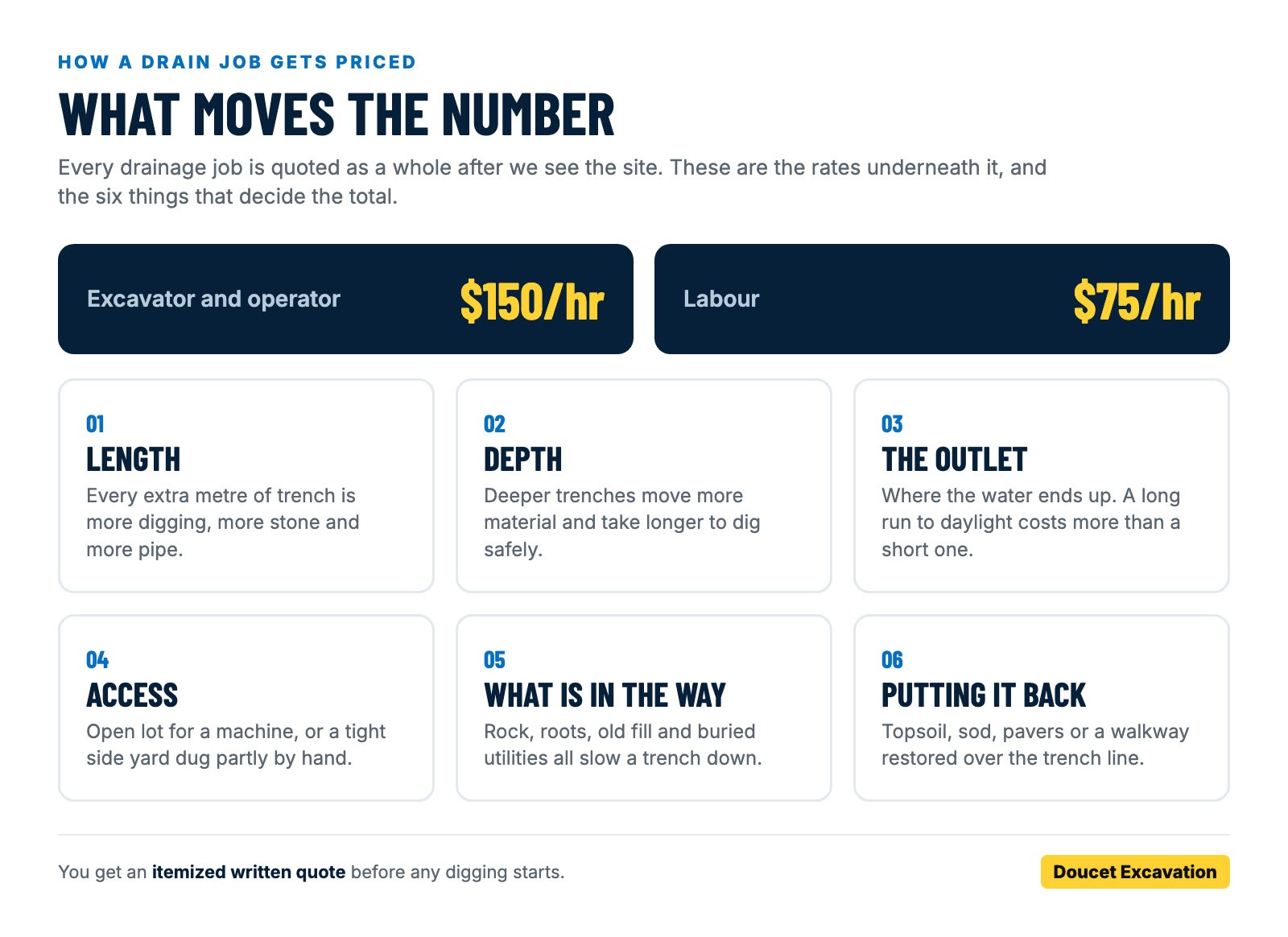
The rates underneath the quote, and what moves the total.
You get an itemized written quote before any digging starts, so you know what you are paying for and why. Payment is 50% up front and 50% when the job is done.
Can you install a French drain yourself?
You can, and plenty of people in Halifax have. If the run is short, the ground is soft, there is an obvious low spot to drain to and you are comfortable setting a consistent slope, it is a real weekend project.
Where DIY drains go wrong is almost always the same list. The slope is off, so water sits in the pipe. The wrong stone gets used, or no fabric, so it clogs. There is no proper outlet, so the water just collects at the end of the trench. Or the digging hits a buried line. Whoever digs, get the utilities located first. It is free, and it is the one mistake you cannot undo with a shovel.
What are the downsides of a French drain?
A French drain needs somewhere to send water. On a flat lot with no low point, that means adding a dry well or catch basin, which adds cost. It can clog over the years if the fabric or stone is wrong, and tree roots will find a wet pipe. And it will not fix a yard that slopes the wrong way. It will just work very hard at it forever.
None of those are reasons not to install one. They are reasons to install one properly, and to make sure a drain is actually the fix your yard needs.
Drainage in HRM: permits and grading
Most yard drains are straightforward. Where a drainage job changes the grade of a property, HRM can require a Lot Grading permit, and changing how water leaves your lot can affect the neighbour downhill. We handle the permitting when a job needs it, and we tell you before the work starts rather than halfway through.

Grade first, then build. Water goes where the ground tells it to.
Why we do drainage the way we do
Most landscape failures in Nova Scotia are drainage failures underneath. A patio that heaves, a wall that leans, a lawn that grows moss instead of grass. Dig into any of them and there is water going somewhere it should not.
We do the excavation and the finish work with the same crew, so the people setting the fall on your drain are the people who come back to lay the sod or the patio over it. French drains, swales, regrading, downspout extensions, catch basins and dry wells are all part of the same job for us: find where the water is actually coming from, and send it somewhere it will not cause trouble.
Every install carries a 1 year workmanship warranty. We are booked about a month out and always taking on new work. If your yard is wet and you are not sure why, call us at (902) 221-4582 and we will come walk it with you.
Frequently asked questions
How much does a French drain cost in Halifax?
It depends on length, depth, the outlet, access, what is in the ground and what has to be restored on top. Doucet quotes every drainage job as a whole after a site visit. The rates underneath are $150 an hour for an excavator and operator and $75 an hour for labour, plus materials, and you get an itemized written quote before work starts.
How deep does a French drain need to be?
A typical yard drain in Halifax runs about 18 to 24 inches deep. The depth is set by where the water sits and where the outlet is. A drain protecting a foundation is set by the footing instead, which is usually deeper.
Does a French drain need to go below the frost line?
For a yard drain, usually not. The frost line here is around four feet, and digging that deep for a lawn drain roughly doubles the work without much benefit. What matters is that the pipe keeps a steady fall to its outlet.
Can I install my own French drain?
Yes, on a short run with soft ground and an obvious place to drain to. The common mistakes are an uneven slope, the wrong stone or no filter fabric, no proper outlet, and hitting buried utilities. Always have utilities located before digging.
What are the downsides of a French drain?
It needs somewhere to send water, which can mean adding a dry well on a flat lot. It can clog over time if built with the wrong materials, roots can get into it, and it will not fix a yard that slopes toward the house. Regrading fixes that.
What can I do instead of a French drain?
Extend your downspouts first, which is the cheapest fix. If the yard slopes toward the house, regrading is usually the right answer. A swale can redirect surface water, and a dry well or catch basin handles low spots with no outlet.
Do I need a permit for drainage work in HRM?
Simple yard drains usually do not. Where a job changes the grade of the property, HRM can require a Lot Grading permit. Doucet handles the permit when one is needed and tells you before work begins.
