Concrete Removal Cost in Halifax: Driveways and Slabs
Concrete removal in Halifax is billed from $150/hour plus disposal. What drives the hours, how driveways and slabs come out, and what is left after.
What concrete removal costs in Halifax: breaking out old driveways, slabs, walkways and steps, what drives the hours, and how the site is left for the new install.
Concrete Removal Cost in Halifax: Driveways, Slabs, Walkways and Steps
Concrete removal in Halifax with Doucet is billed from $150 an hour plus disposal. That covers breaking out the old concrete with the excavator, using a hammer attachment for thick or reinforced pours, then loading it and hauling it off site. Old asphalt and paver driveways are handled the same way, and the site is left clean and ready for the new install.
Concrete removal at a glance
Rate: from $150 an hour plus disposal
What we remove: concrete driveways, slabs, walkways, steps and footings, plus asphalt and paver driveways
Equipment: excavator, with a hammer attachment for thick or reinforced concrete
Included: breaking, loading, hauling off site and cleaning up
Left behind: a clean site, ready for the new install
Quote: one flat written quote within 24 hours of the site visit

Why concrete removal is priced by the hour
Two driveways that look the same from the street can be very different jobs once the bucket goes in. One is a thin pour sitting on gravel that breaks up in big clean slabs. The other is thick, full of rebar or wire mesh, and poured over another layer of old concrete nobody remembers. You cannot tell which one you have from a photo, and often not until the first piece comes up.
That is why the work is built on machine time at $150 an hour, with disposal on top. We still give you a number up front. We walk the property, look at the thickness where we can see an edge, check the access, and send one flat written quote within 24 hours.
What drives the hours
Thickness and reinforcement
This is the big one. A thin walkway or patio slab cracks apart with the bucket. A thick driveway, or anything with rebar or mesh in it, needs the hammer attachment to break it into pieces small enough to load. The steel then has to be pulled out of the broken concrete or handled with it.
Concrete, asphalt or pavers
Asphalt is usually quicker to break up and load than thick concrete. Paver driveways are different again, because the pavers lift rather than break, and the old base underneath is often the bigger part of the job.
Access
If the truck can back right up to the work, the machine loads it directly and the job moves fast. If the slab is in a backyard behind a fence, every load has to travel, and that adds hours.
How much material there is
Concrete is heavy. A full driveway is a lot of loads, and disposal is billed on top of the hourly rate for that reason. The more there is, and the thicker it is, the more trips it takes.
What is underneath
Sometimes the concrete comes off and the gravel under it is fine. Sometimes there is an old asphalt layer, wet clay or another slab. If the ground needs to be dug down for the new surface, that is excavation, at the same machine rate.
Steps, walkways and footings
Concrete steps against a house take more care than a driveway in the open. The hammer has to break the steps without shaking or chipping the foundation wall behind them, so the work near the house slows down. Walkways are usually quick, unless they run along a narrow side yard where only a small amount of material can come out at a time.
Footings are the hidden part of a lot of removal jobs. Old deck posts, shed pads and fence footings are often set in concrete below grade. If you are putting something new in that spot, they need to come out too, or they will be in the way of the new base.
What is left when we are done
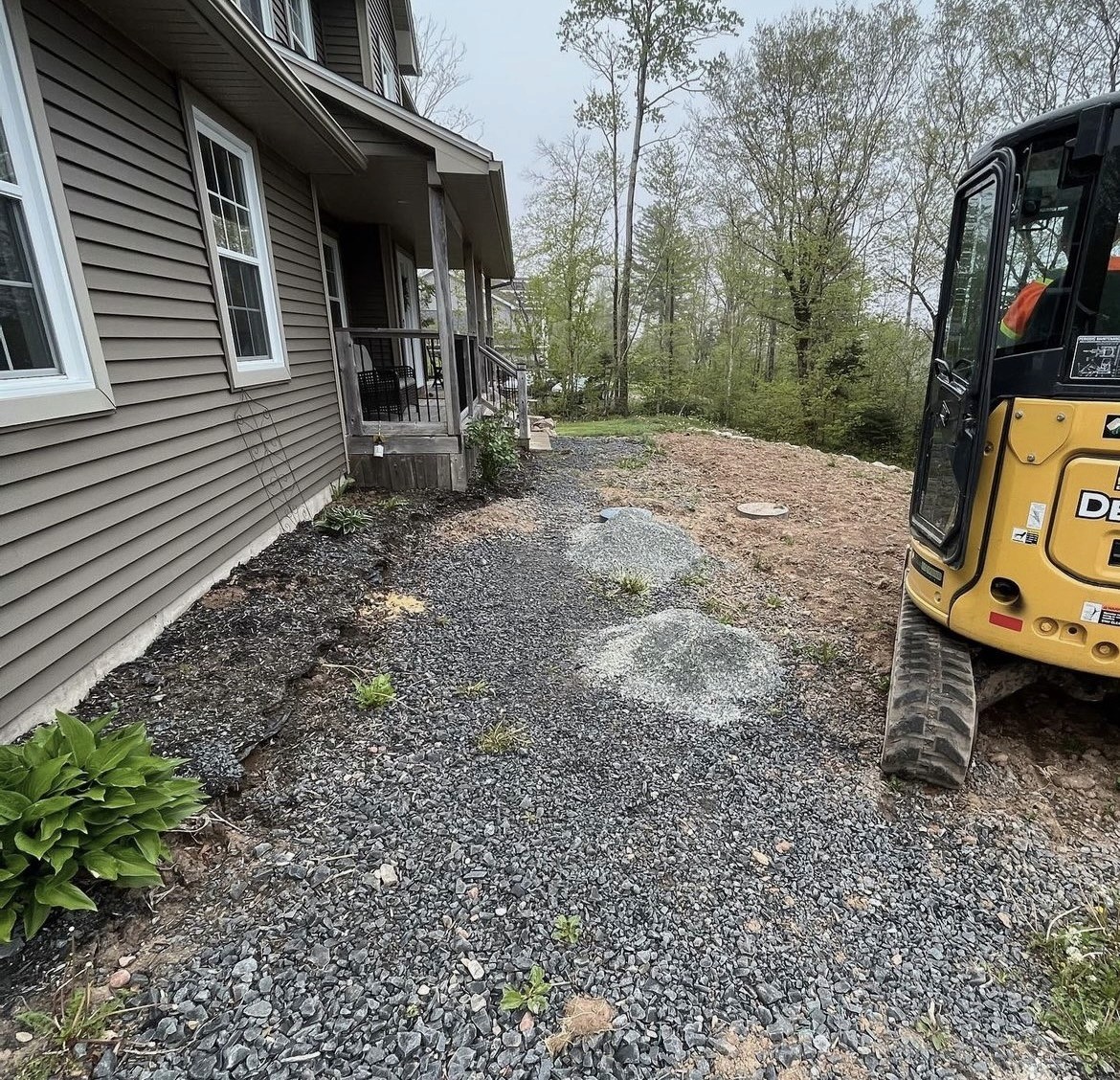
When the concrete, asphalt or pavers are gone, the broken material is loaded and hauled off site and the area is cleaned up. You are left with open ground ready for the new install, not a pile of rubble and a rough hole.
What happens next depends on what is going in. If you are putting in an interlock driveway, the new surface goes down on 6 to 10 inches of compacted gravel base, and the removal is planned so that base can go straight in. See what an interlock driveway costs in Halifax for that side of the job. If the old driveway sloped toward the house, this is the time to fix the grade, while the ground is open.

Why it helps to use one crew for removal and the new install
When one company breaks out the old driveway and another one comes in later to build the new one, there is a gap. The ground sits open, weather gets into it, and the second crew often has to redo some of the prep. When the same crew does both, the removal is done with the new base already in mind, and the base goes in right after.
We do the removal, the excavation and the paving stone work ourselves. Our hardscape page shows the kinds of driveways, walkways and patios we build once the old surface is out. Every install we build comes with a 1 year workmanship warranty, and Jack is on pretty much every job site.
Questions worth asking before removal starts
Ask whether disposal is in the quote and how it is counted. Ask whether the old gravel base is staying or coming out, because that decides how deep the new install has to dig. Ask who is responsible for the open ground between the removal and the new surface, especially if two different companies are involved. And if the slab is up against the house, ask how the work near the foundation will be done. A contractor who has done a lot of these will have a straight answer for every one.
Can you break out concrete yourself?
A short, thin walkway can be broken up by hand with a sledgehammer or a rented breaker if you have the time and the back for it. The hard part is usually not the breaking. It is moving the pieces, because concrete is much heavier than it looks, and getting rid of it properly. Once you are into a driveway, a thick slab or anything with steel in it, a machine with a hammer attachment does in hours what would take a person days.
Frequently asked questions
How much does concrete removal cost in Halifax?
Doucet bills concrete removal from $150 an hour plus disposal. The total depends on thickness, reinforcement, access and how much material has to be hauled. We walk the job and send one flat written quote within 24 hours.
Can you break out thick or reinforced concrete?
Yes. Thick or reinforced pours are broken up with a hammer attachment on the excavator, then loaded and hauled off site.
Do you remove asphalt and paver driveways too?
Yes. We tear out old concrete, asphalt and paver driveways, break them up, load them out and leave the site ready for the new install.
Is disposal included in the hourly rate?
No. Machine time is from $150 an hour and disposal is added on top, because it depends on how much material there is and how heavy it is. Both are rolled into your written quote.
What is left after the old driveway is removed?
A clean site ready for the new install. If an interlock driveway is going in next, it goes down on 6 to 10 inches of compacted gravel base, and the removal is planned around that.
If your old driveway is cracked, heaved or just finished, call (902) 221-4582 and have us look at it before you plan the new one.